
Touring to Skiathos Island
Local
Skiathos is a paradise island in the Aegean, at the feet of Mount Pilion and north of Euboea (Evia). Together with the neighbouring islands of Skopelos and Alonnisos to the east, and Skyros to the southeast, they form the Northern Sporades group, known since ancient times. Skiathos has regular boat service to the other islands of the group, as well as to Euboea, Agios Konstantinos, Volos and Thessaloniki, while there are also daily flights to and from Athens all year round.
Skiathos is a paradise island in the Aegean, at the feet of Mount Pilion and north of Euboea (Evia). Together with the neighbouring islands of Skopelos and Alonnisos to the east, and Skyros to the southeast, they form the Northern Sporades group, known since ancient times. Skiathos has regular boat service to the other islands of the group, as well as to Euboea, Agios Konstantinos, Volos and Thessaloniki, while there are also daily flights to and from Athens all year round.
The Name
The name ‘Skiathos’ derives from the Greek word for shadow (‘skia’) and was given to the island because of the lush forests that ‘shadow’ it from one end to the other.
Geography and Climate
The island covers an area of 61 square kilometres, with a coastline of approximately 30 miles. It is mountainous for the most part, with low wooded hills.
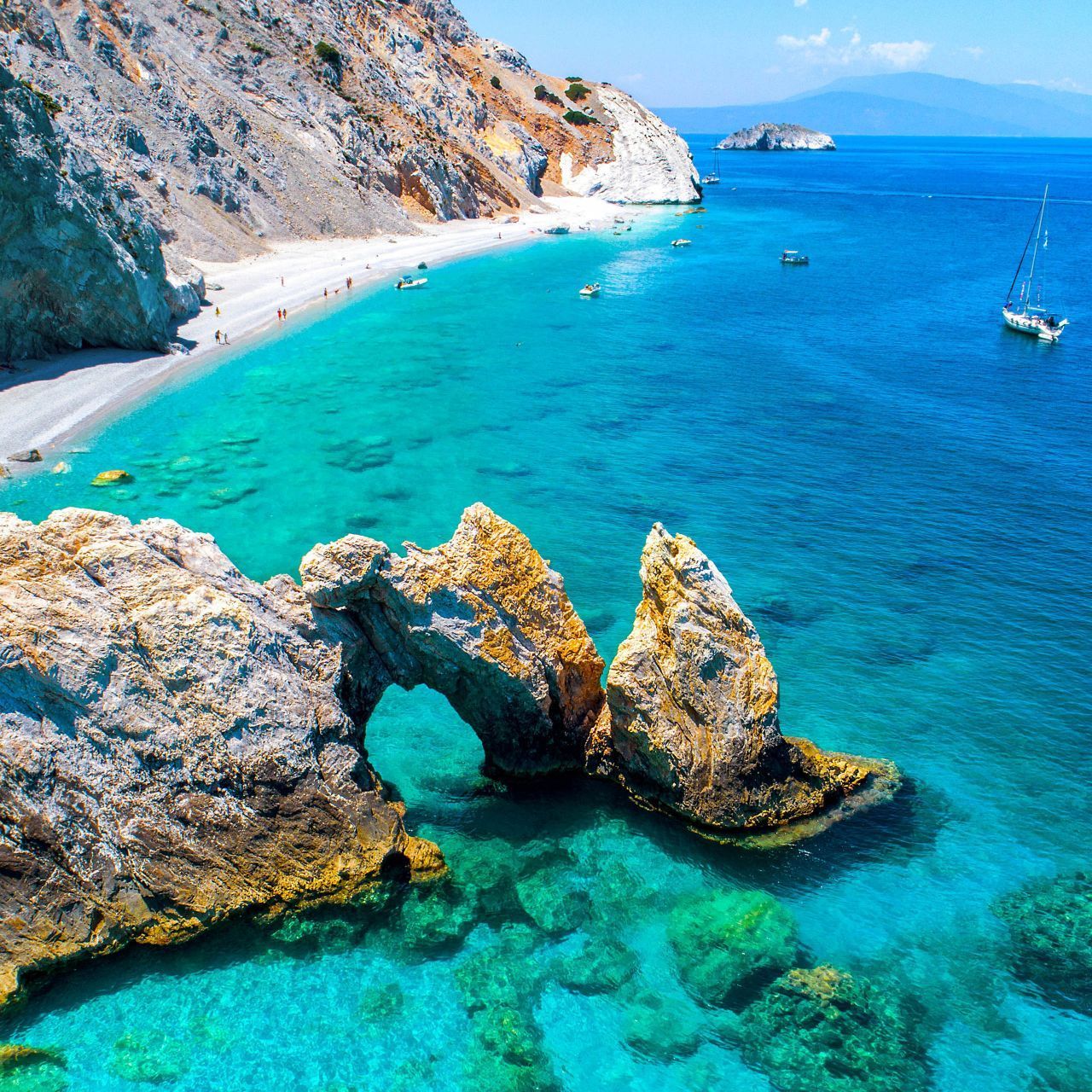
The northern side, exposed to the strong wind, consists of steep cliffs and rugged shores like stunning Lalaria with the renowned, unique ‘Tripia Petra’ (‘Punctured’ or ‘Pierced Stone’) jutting out into the sea.
The south-western side though, where the coastline is three times longer and sheltered from the north wind by the mainland and the surrounding islands, consists of countless inlets and coves with alluring beaches. Among them the famous Koukounaries –one of the world’s most breathtaking locations: blue-green waters, a seashore made golden by the fine sand and the bright sun, a lagoon with migratory birds and a forest whose trees touch the waters. Together, they form a remarkable landscape dominated by the tall trees (stone pines or ‘koukounaries’) that captivates the visitor with its beauty.
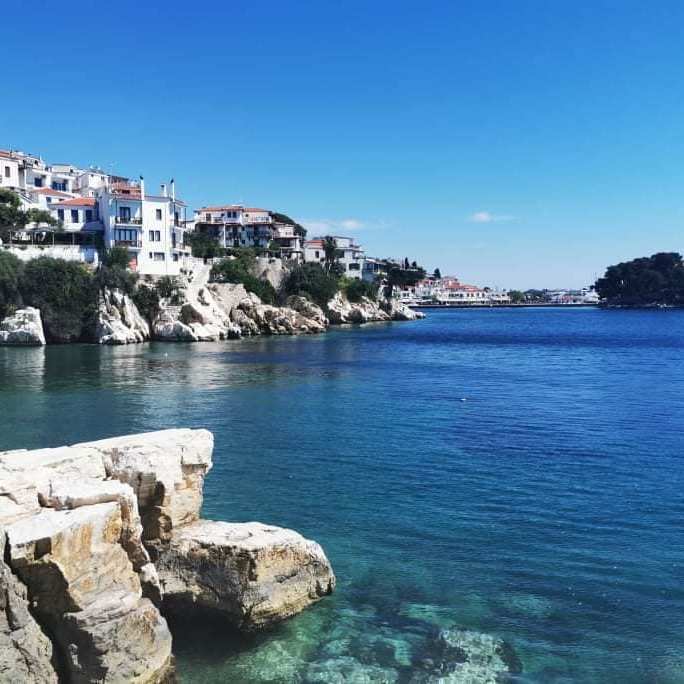
On the eastern side, in a wooded bay, stretched across two opposite hills, stands the island’s only town also named Skiathos. Its picturesque harbour is intersected by a pined peninsula, the Venetian Bourtzi, which hosts the maritime museum, the conference centre and the open air theatre.
The island’s highest mountain is at 433 m; below its peak winding footpaths weave their way through pine, plane and olive trees, leading to spurting springs, murmuring creeks and humble chapels, as well as notable monasteries.
Skiathos’ flora includes over 750 plant species, with fragrant herbs such as mint, oregano and sage, to name a few.
Scattered around Skiathos are 16 uninhabited islands and islets. The most renowned is Tsougrias; with an area of approximately 1.2 square kilometres, it lays a very short distance from the harbour (15 min. by boat). It’s one of the most beautiful uninhabited islands of Greece, with 6 stunning beaches and lush vegetation.
The island’s climate is mild and healthful. The surrounding sea is safe and friendly and on the southern side, usually calm. It is a sea which softly caresses the island’s serpentine shoreline, gently slips into and plays with its blue seaside caves, sculptures its rocks and cools its capes.
The island
Culture and History
The most celebrated among these is the Monastery of Evagelistria –dedicated to the Annunciation– which contributed significantly to the success of the 1821 Greek War of Independence and the consequent liberation from the Ottoman yoke after four centuries of oppression. Indeed it was here the first Greek flag was designed and blessed in 1807. The Monastery houses a fine museum with rare manuscripts; it also produces the famed ‘Alypiakos wine’ which, according to tradition, drives away sorrow.
At the northernmost tip of the island a gigantic rock a hundred fathoms high and two furlongs wide juts out from the cliff. There stands the medieval ‘Kastro’ (Fortress) of Skiathos that housed the islanders for five long centuries (1350 – 1829) when, for fear of pirates, they abandoned the present town and secured themselves behind its gates. There are daily excursions by boat from the town port to Kastro, after of course, a stop for a swim at spellbinding Lalaria with its white pebbles and crystal blue waters.
Furthermore, to the northeast, two miles out of town, lays the hill of Kefala, where ongoing archaeological excavations unearthed evidence that the first settlement on the island was established in early historical times (11th century BC) by the Euboeans.
The history of Skiathos dates back many centuries, as do its traditions. Here, in 480 BC, Xerxes, the mighty king of Persia, anchored his fleet in Mandraki (or ‘Port of Xerxes’) during the second Persian invasion of Greece, when his advance was hindered at the narrow pass of Thermopylae, on the mainland opposite the island, by the fearless Leonidas and the Spartans. Soon after, Themistocles scored a decisive victory against the Persians in the famous naval Battle of Salamis where, if the outcome had been in favour of Xerxes, the future of Europe would quite possibly have been dramatically different and Ancient Greek literature would most likely have been lost.
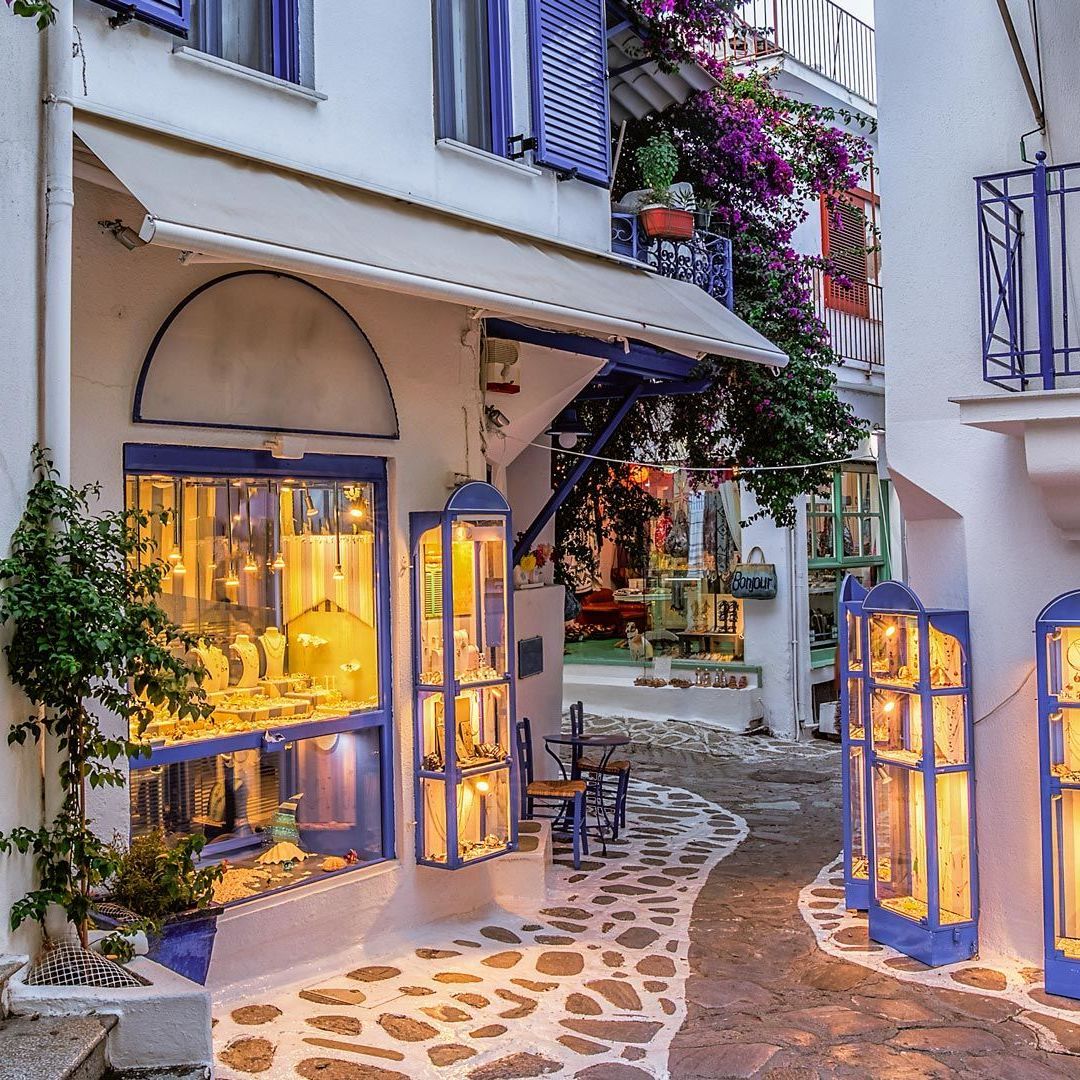
For the most part, the modern city of Skiathos preserves its traditional colour. Narrow, cobbled streets flanked by flowered courtyards of basil and bougainvilleas enchant the visitor and send him back through time, to the age of innocence. Among the two storey houses, alluring with the smell of traditional local sweets, that of Alexandros Papadiamantis, one of the greatest Greek novelists, who was born and died here (1851 – 1911), merits a special reference. Today the house is a museum.
Skiathos, therefore, has much to offer the restless visitor besides the things that put her on the global map as a top-notch tourist destination: a cosmopolitan atmosphere, enticing waters, delightful sunshine, fresh air and profuse vegetation…
Enjoy your stay and leave no stone unturned…

Bourtzi
In Skiathos there are two ports, the commercial and the old, which are separated by the Peninsula (Island) of Bourtzi. In 1207 the Gyzi brothers descended the island and built the small Venetian fortress, Bourtzi. Bourtzi was ineffective in protecting the population and in the middle of the 14th century the capital was moved to KASTRO.
For more than 2 decades, Bourtzi has been operating as a cultural center and of course it is a beautiful tourist attraction.Also Since 2015, opened the beautiful Skiathos Naval Museum in Bourtzi.
Lalaria
At the northeastern end of the island is Lalaria beach, one of the most beautiful in Greece. Its majestic appearance evokes awe and admiration in visitors who see it for the first time. The huge stone with the famous hole in the middle is a unique element of nature which will really impress you.
The wild beauty of the landscape combined with the crystal clear waters and white pebbles that the locals call “lalaria” enchants visitors by giving an unforgettable memory.
There are two ways to visit the beach, starting in the morning with day trips from the port or you can rent a small boat.
Plakes
At the end of the old port between the fishing shops and the little sandy beach of Zacharaki, the wide steps will lead us to the area of Plakes.
Get lost in the alleys and the quiet traditional cobbled streets and at the end you will find in front of you the unique beauty beach plakes. You can swim in the crystal clear waters and take magical photos of the old port of Skiathos. Going down to Plakes on the left you will see an image that has been captured in thousands of photos, a small beach and the a tavern that touches the sea. A tavern that operated in the 80’s and today many call it the tavern of lovers. A visit to the fairytale neighborhood will be unforgettable.
Enjoy your Vacation
Location
Ammoudia
Skiathos, 370 02 Magnisia
Greece
Reservation
(+30) 698 672 0012
skiathosdelsolsuites@gmail.com
 Del Sol Suites